
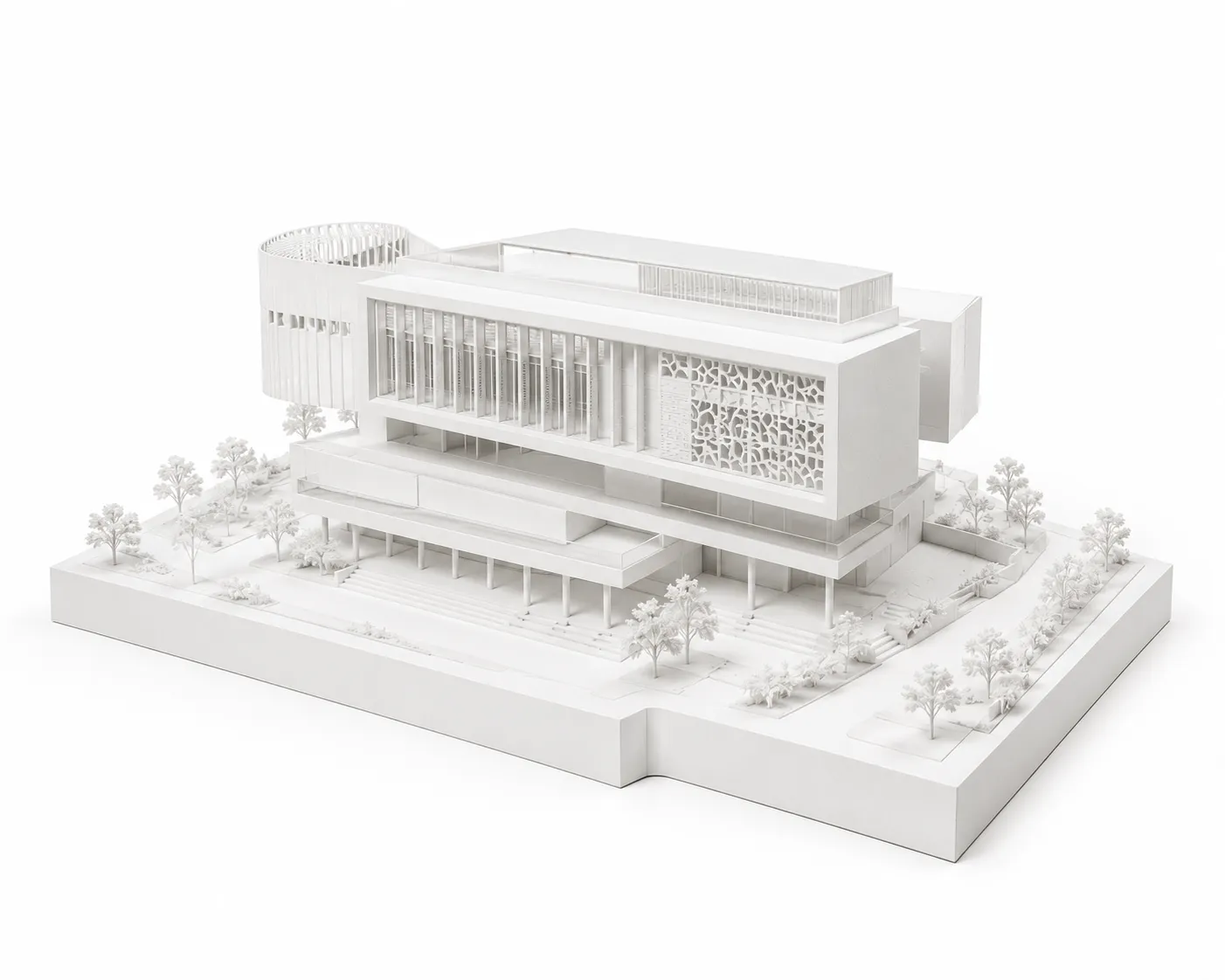
In the architectural design process, the conceptual model occupies a unique and irreplaceable position. It is the moment when a design idea — still fluid, still being tested, still open to revision — first takes physical form. The act of making a conceptual model reveals things about a design that drawings and digital renders cannot — the actual three-dimensional spatial relationships, the scale of the massing relative to its surroundings, the way light falls across the forms at different angles.
AestheticSilai’s Conceptual Architectural Models are produced at the early stages of the design process to support exactly these discoveries. Our conceptual models are typically produced in white or near-white materials — the absence of colour and material specificity keeping attention on the essential qualities of massing, proportion, and spatial organisation rather than on surface and finish.
Production uses a combination of precision 3D printing (for complex curved forms and intricate massing elements), laser cutting (for clean flat and geometric planes), and hand assembly and finishing. We work from your earliest schematic drawings, massing diagrams, or digital 3D files — whichever stage of documentation you have available.
Conceptual models from AestheticSilai are typically produced at scales between 1:200 and 1:500, allowing the full site context to be included where relevant. Faster turnaround times are available for competition deadline situations.
These models are the working tools of design — they should be handled, adjusted, and explored. We build them to be robust enough for that engagement while maintaining the clarity and precision that makes them useful communicators.

Reviews
There are no reviews yet.